
GPR Concrete Scanning & Private Utility Locating
Concrete Imaging
for Real Construction Decisions.
From the team that’s helping define the next generation of concrete imaging, investigation, and construction support.
1964
Trusted Since
Ontario-Wide
Coverage
GPR + X-Ray
Advanced Imaging
Scan → Image → Cut
Complete Solution
Why CANCUT
Why Choose Canadian Cutting & Coring
We help engineers, project managers, and contractors understand what the findings mean for the work ahead, then execute that work ourselves. From scanning and imaging to cutting and coring, six decades of concrete expertise stand behind every decision.
That’s a very different level of accountability.
We are not a scan-only specialist. Canadian Cutting & Coring scans, images, cuts, and cores under one roof, so a project moves from investigation to execution without handing off between trades.
Detailed reports, marked drawings, annotated photographs, findings summaries, and project documentation designed to support construction planning and engineering review.
Request a Sample ReportNot every investigation can be solved with GPR alone. When conditions require a higher level of certainty, our team can provide radiographic imaging and advanced investigation techniques to support critical decisions.
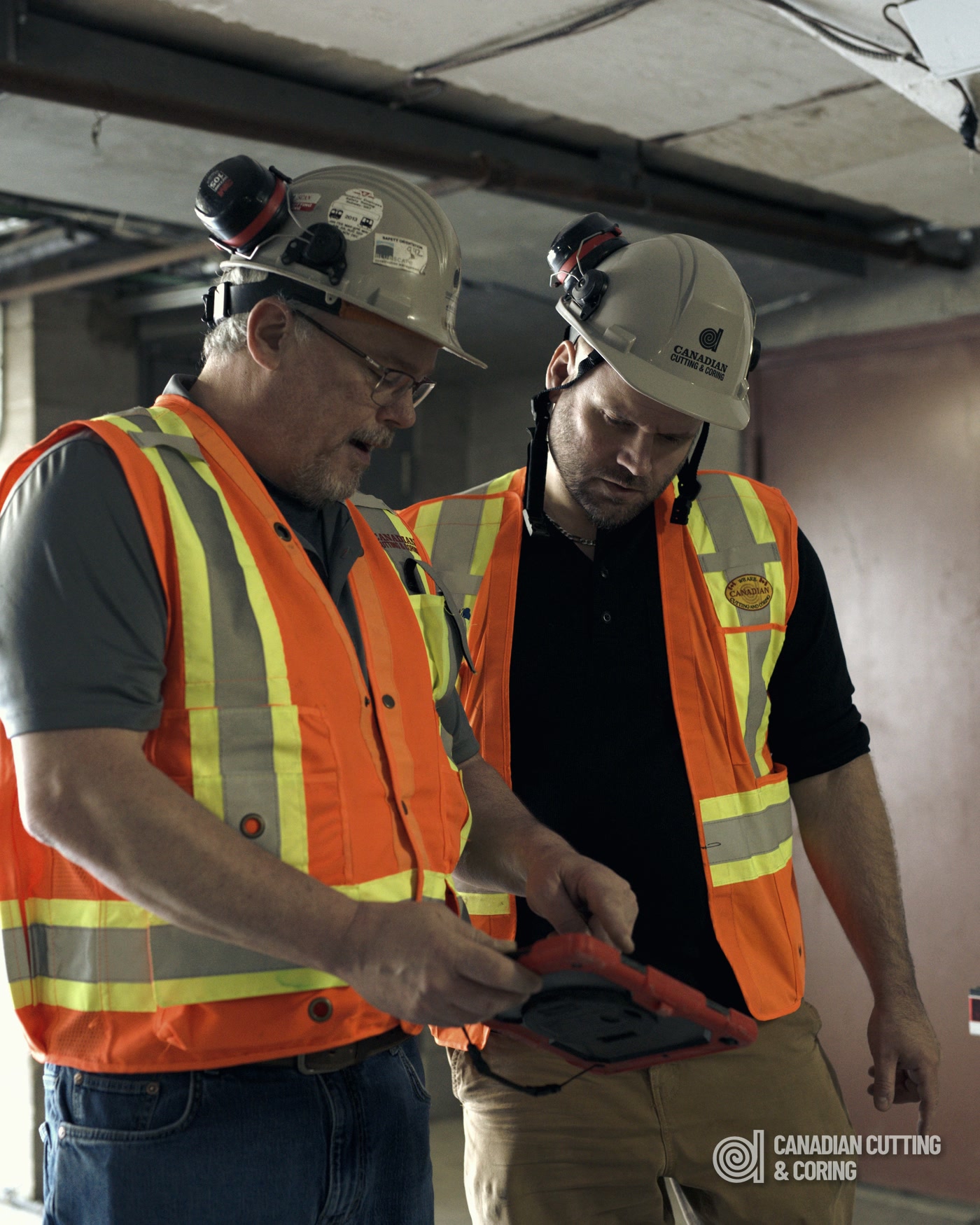
Our Damage Prevention Technicians (DPTs) go beyond basic equipment readings to deliver sophisticated analysis of complex, heavily congested slabs.
Scanning and coring handled in a single visit, so findings are reviewed and openings are cut the same day without booking a second trip.
Trusted on Ontario projects since 1964, with the field experience to know how scan data translates into the cutting and coring work that follows.
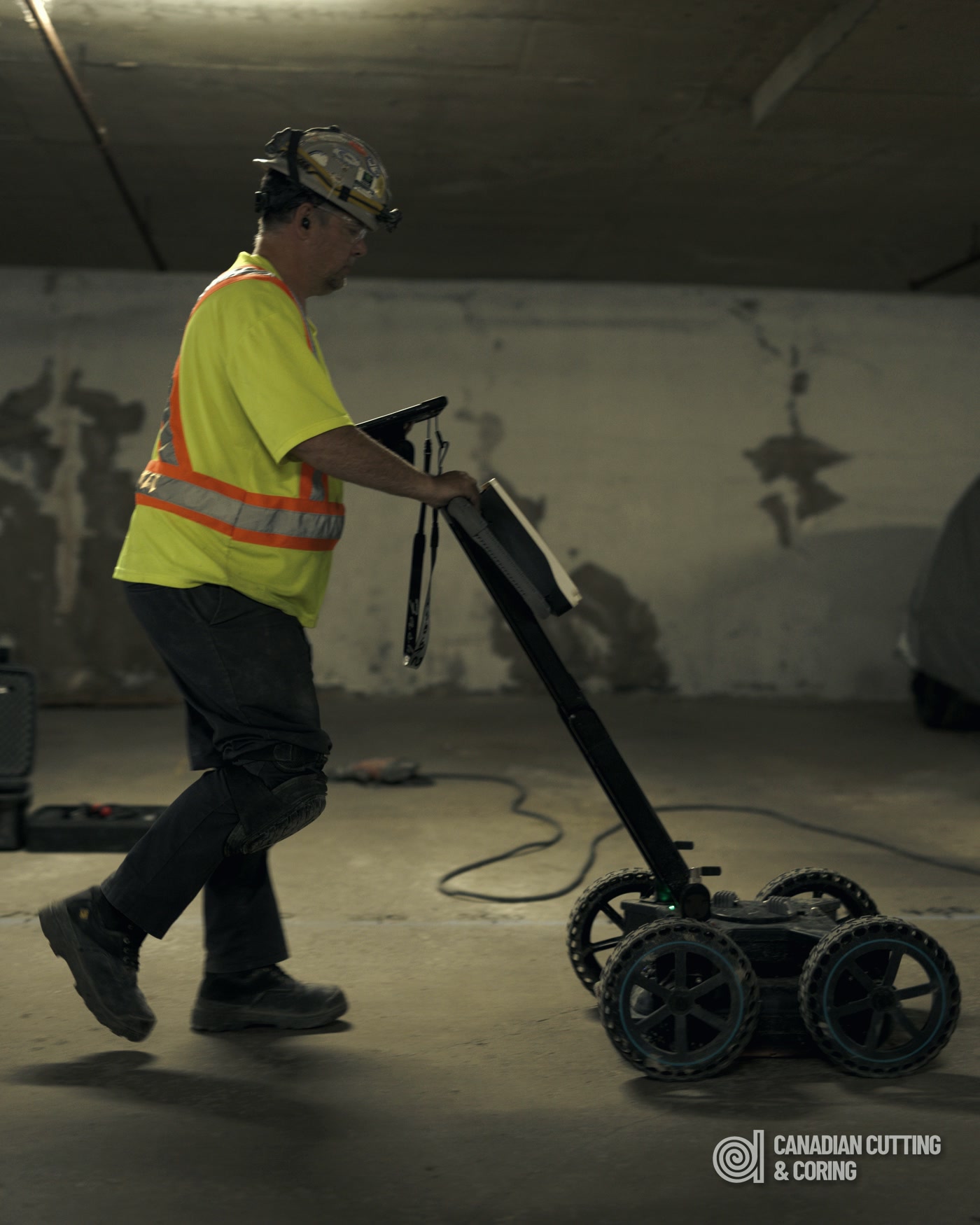
Concrete Imaging Fundamentals
What Is GPR Scanning?
Ground Penetrating Radar (GPR) is a non-destructive concrete imaging technology used to characterize embedded conditions within concrete structures before construction work begins.
GPR investigations provide critical information regarding the location, depth, orientation, and spacing of embedded features such as reinforcing steel, post-tension cables, electrical conduit, piping, sleeves, and other subsurface obstructions. The information gathered is used to evaluate risk, plan penetrations and openings, verify existing conditions, and support informed construction decisions.
Unlike exploratory demolition or destructive investigation methods, GPR provides immediate insight into existing conditions while maintaining the integrity of the structure and minimizing disruption to occupied spaces.
What we find
What GPR Reveals Inside the Concrete
A single scan maps the hidden hazards and structural details that determine where you can safely cut, core, and drill.
Training & Certification
Technology Matters. Training Matters More.
Ground Penetrating Radar has become more accessible than ever, and many companies can buy the same equipment. What sets the results apart is the training and certification of the technician reading them.
Every drilling location, every core hole, every saw cut, and every construction decision is ultimately based on the technician’s ability to correctly identify and interpret what exists inside the concrete.
That’s why Canadian Cutting & Coring places such a strong emphasis on professional training and Damage Prevention Technician (DPT) certification.
Certified & Accredited


Our technicians hold Damage Prevention Technician (DPT) certification through the ORCGA.
Canadian Cutting & Coring is also a member of the North American Private Utility Association (NAPUA), a non-profit working to formalize private utility locating standards and close the safety gap in ground disturbance work.
The difference
The Canadian Cutting & Coring Difference
Our technicians are trained to understand not only what the equipment detects, but what those findings mean for the work that follows.
Because we routinely perform the cutting, coring, and modifications that depend on accurate scan results, we understand the practical consequences of missed information and the importance of getting it right.
Our approach combines
The result is more than a scan. It’s information project teams can use with confidence.
In their words
The technician carefully marked all 2,300 square feet of our basement and located the in-floor heating tubing with remarkable precision. Because of his expertise, we drilled more than 300 holes in the concrete without a single incident.
Questions
Frequently Asked Questions
Answers to common questions about Ground Penetrating Radar (GPR), concrete imaging, radiographic imaging, project planning, limitations, and construction decision-making.
Browse by topic
General Questions
Ground Penetrating Radar (GPR) is a non-destructive concrete imaging technology used to characterize embedded conditions within concrete structures before construction work begins.
GPR investigations provide critical information regarding the location, depth, orientation, and spacing of embedded features such as reinforcing steel, post-tension cables, electrical conduit, piping, sleeves, and other subsurface obstructions.
GPR transmits high-frequency electromagnetic waves into concrete and analyzes reflected signals from embedded objects and material boundaries. Differences in material properties allow reinforcing steel, conduit, post-tension cables, slab interfaces, and other embedded features to be detected and mapped.
Yes. GPR uses low-power electromagnetic signals and does not emit ionizing radiation. Investigations can typically be performed safely in occupied offices, hospitals, schools, retail facilities, and operating buildings without exclusion zones.
Yes. GPR investigations can be performed on slabs, walls, beams, columns, ceilings, and other concrete structures.
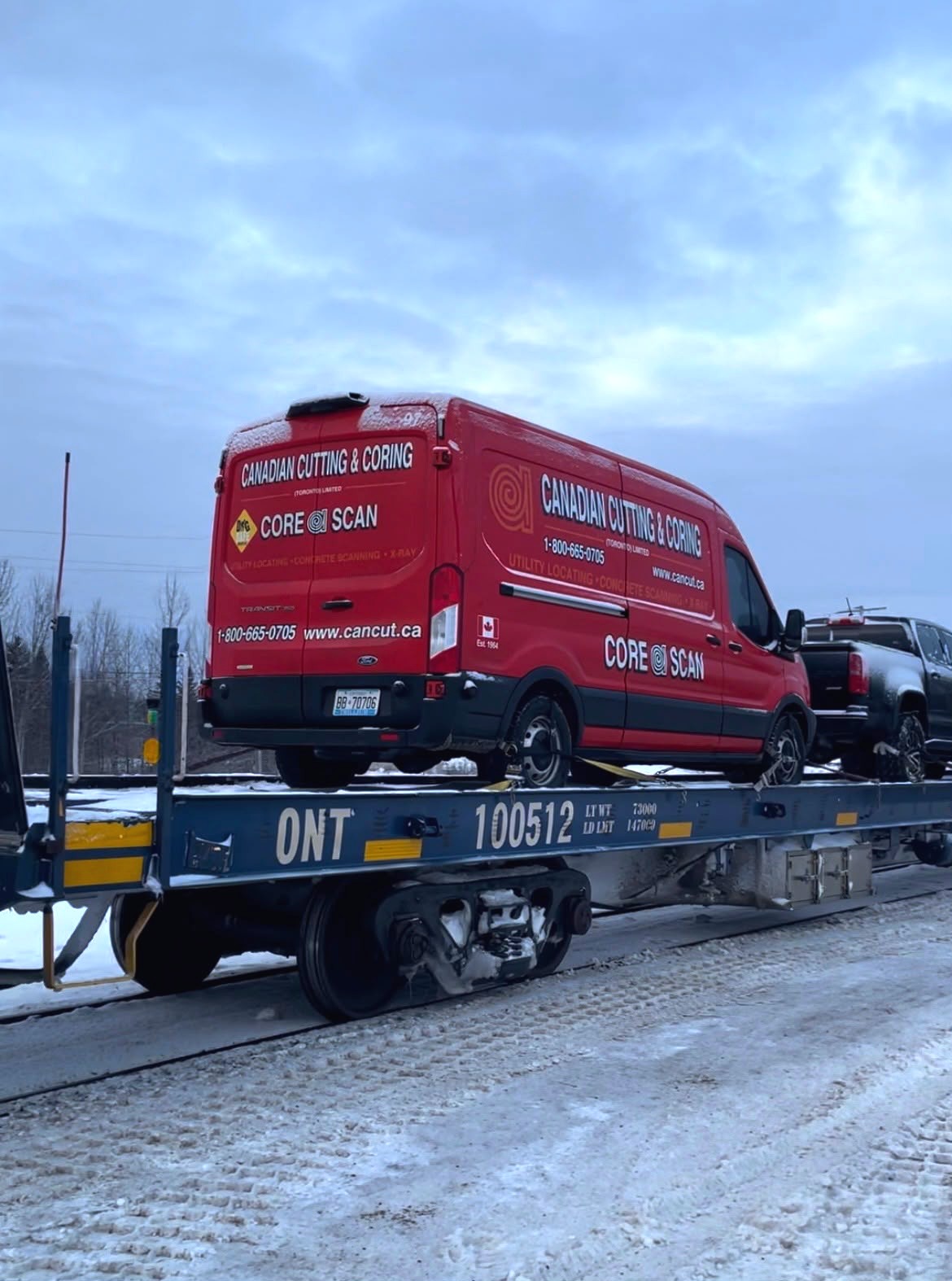
No site
too remote.
By road or by rail, wherever the project takes us, we mobilize to get the scan done.
Where we scan concrete
Trusted on Ontario’s Most Demanding Projects
From hospitals and transit systems to industrial facilities, data centres, and critical infrastructure, Canadian Cutting & Coring provides the imaging information project teams rely on before cutting, coring, and drilling begins.
Based in the Greater Toronto Area·Trusted across Ontario
Available nationwide for critical projects and specialized concrete imaging services.
From the Journal
Go deeper on
concrete scanning.
Need certainty before you cut?